I’d like to discuss for a moment those effigies, fetishes, or “Story Stones,” if you will, that were left by Palaeo-Americans. Likely products of the Clovis archaeological culture, they are well-conceived flaked and sculpted stone figural representations. Story Stones have been found on the surface of known Clovis sites bordering Pleistocene Lake Manix, California. Each of the stones depicts a story, theme, or tradition.
These stones have certain characteristics in common. Noteworthy are the types of images that are depicted. Both Pleistocene mega-fauna and human (perhaps shamans or deities) faces or face-profiles are shown. Some of the animals that occur are 1) mastodon, 2) mammoth, 3) mega-cat, 4) (Giant) beaver, 5) vulture/condor, 6) bison (likely ancient varieties), 7) bear, 8) wolf, 9) coyote, 10) porcupine, 11) snake, 12) horse, and 13) other birds. Animal images vary in frequency with mammoth and mastodon being the most common. Usually, two or more animal faces are depicted upon single Story Stones. All stones incorporate human (shaman, deity) faces or face-profiles, which often are horned, capped, and bearded.
Another common characteristic of Story Stones is that makers employed natural inclusions, holes, and veins in the stone for their manufactures. They worked around these natural features and incorporated them within images. The ancient sculptors were clever and creative.
Story Stones were often made on flakes. All examples known to date have been found upon the surface, and typically they are heavily patinated and wind-blown from prolonged exposure. Edges are smooth and may exhibit special edge-grooving and sculpting. Story Stones usually are small in size, fitting comfortably within the palm of the hand. A few are quite large and measure more than a foot in length. But, nonetheless, all are portable. Their outlines may have flowing curvatures without signs of wear. Most Story Stones have protrusions around the perimeter that image ears, beaks, or horns (perhaps on a shaman’s costume). Eyes and mouths of images are either chipped and flaked or incorporate natural inclusions. Noses are usually intentionally sculpted, although some are based upon natural inclusions. Hair upon the head and beards are often sculpted by application of pressure-flaking or by utilizing natural stone features.
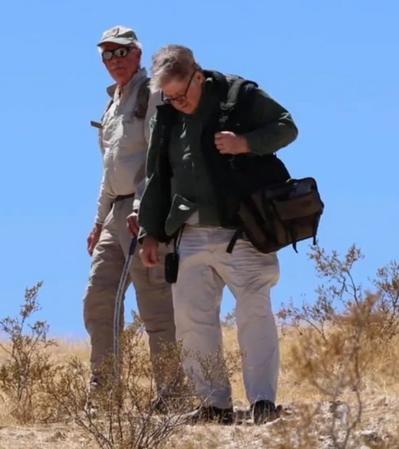
Dr. Michael Gramly and Richard Dempsey at Clovis site bordering Pleistocene Lake Manix, California
Figure 1.
Examples of eyes that were depicted by natural holes or inclusions within the stone. A, note the circular eye upon the sculpture of a mammoth, facing left (This specimen has been dubbed the “California Rainbow Mammoth.”); B, large eye upon the sculpture of a human (shaman, deity), facing left); C, flaked mass with human facial profiles (shaman profiles?)
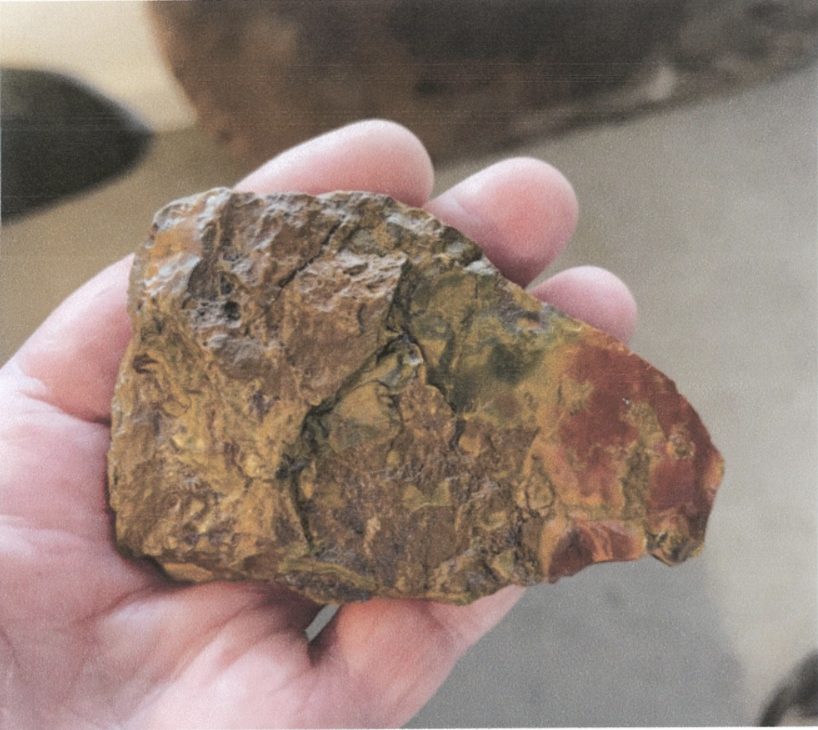
Figure 1. A
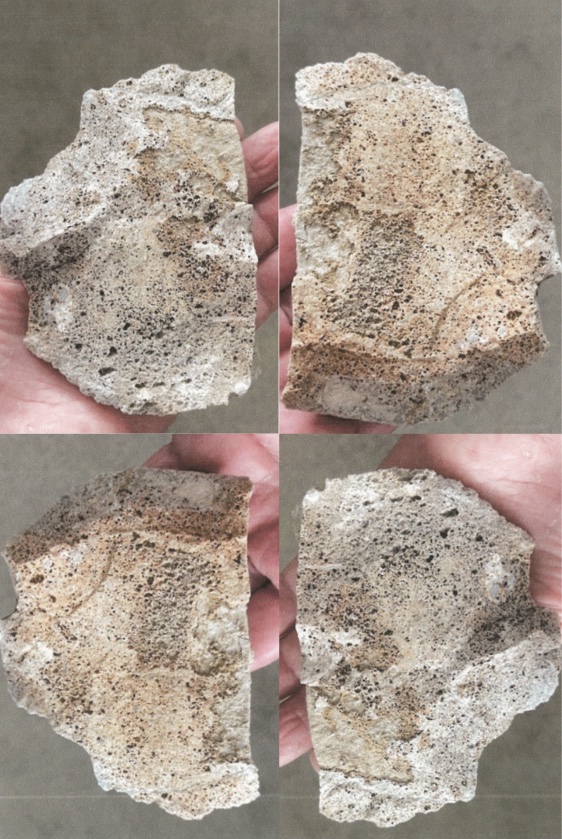
Figure 1. B

Figure 1. C
Figure 2.
Views of the “California Rainbow Mammoth” sculpture. This beautifully-colored Story Stone was found at a Clovis site along the shore of ancient Lake Manix. This outstanding piece portrays several animals as well as a human face in profile. As shown here, a mammoth (perhaps a Wooly Mammoth) faces left. Its eye is a natural hole in the stone. The head has been sculpted by reducing the mass behind the head leaving it in high relief. Flaking has exposed the beautiful red, green, and yellow petrified wood; likewise, the brown-colored hair of the mammoth’s head and belly has been enhanced. A vulture or other bird-of-prey has been imaged, facing right. When the mammoth image is held upside down, a full-figure bison can be seen. On the cortex a person’s face, perhaps that of a shaman, is displayed. A wolf’s head is also imaged on both sides of this sculpture. This artifact no doubt tells quite a story. Dimensions are 3 3/4″ wide, 2 3/8″ maximum height, and 1/2″ thick.
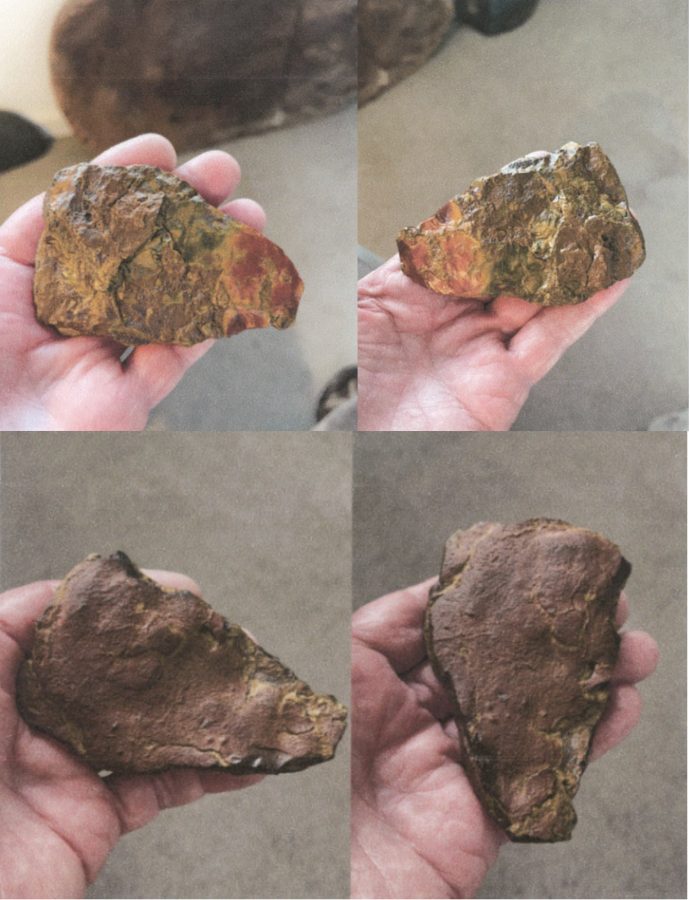
Figure 2
Figure 3.
This wonderful example of a Story Stone was found at a Clovis site along the shore of Lake Manix, Mohave Desert. It was a surface find and is heavily patinated upon one face. The opposite face is white and orange in color. The unweathered chert is gray. It depicts a human head (perhaps that of a shaman) with hair piled in a topknot or wearing a small cap. The eye of the figure is a large natural hole. The nose faces left and is well sculpted; while, the figure’s mouth is open, as if speaking. Turning the piece sideways with the nose facing down, we see the head of a mega-cat facing right. When turned in the opposite direction, we see the horned head of a bison. Turning it in the reverse, we observe two different human faces. One of them wears a horned cap, and the other appears to have its hair bound up on top of the head. The face with the hair bunched up on top of the head has an open mouth, as if speaking. Turning the reverse sideways, we see a bear’s face looking to the right. To the left is the head of a mega-cat – perhaps a lion. It is truly a wonderfully informative Story Stone depicting what may have been a shaman 13,000 (or more) years ago. Dimension are 3 3/4″ X 2 3/4″ X 1/2″.

Figure 4
Palaeo-American Story Stones, through their recurring imagery, portray traditions or possibly what might be called – religious beliefs. A common theme is an association of human faces, perhaps shamans or deities, with images of proboscideans – mammoths or mastodons. A human face was often portrayed below the belly of a proboscidean, looking down. A face, looking forward, may also be shown in front of a proboscidean head or on top of its head, looking upward. Many Story Stones project such a duality. This imagery may tell a tale of a hunt Involving the rite of manhood. It might also hint at a belief that men and proboscideans were related — even that man was born of a proboscidean mother. Analogously, the Pre-Columbian Olmecs believed that man evolved from a jaguar – the “Were-Jaguar” tradition.
Another commonly recurring theme is “old age” versus “youth.” Both human faces and animals are depicted as young and old. Dr. James Harrod, an expert in Eurasian Upper Palaeolithic art and beliefs, has described this duality as older and younger brothers. It appears that the “Two Brothers” theme may have come to North America with immigrants during the Pleistocene. All animal types portrayed upon Story Stones may exhibit this duality of young and old — a reflection of their life cycles. Man’s perspective upon life and death may be expressed in these associated images.
Another frequently seen image upon Story Stones is a human face with an open mouth. I believe that this convention indicates talking or singing. These human depictions often wearing a horned cap or head dress, which might have been made of skins of cats or bison. Alternatively, humans have no cap or headdress and instead show hair piled atop their heads, as a top-knot. In addition, a human may be depicted wearing a beard. Hair may be indicated using natural features of a stone.
Figure 5.
This large Story Stone has been made from an anciently broken Clovis, platter-like biface — popularly known as a “sunfish.” It was found on the shoreline of Pleistocene Lake Manix. On both faces we see a full-figure proboscidean – perhaps a mammoth. This full-figure mammoth faces right upon the orange-patinated side and left upon the gray side. Both mammoth images display a human (shaman?) face looking outward from the rear of the creature. When we turn the piece vertically, we have other human profiles on all four edges. The four faces are beautifully sculpted as well as a fifth face looking upward from the mammoth’s back. These facial profiles incorporate natural inclusions within the rock as eyes. This sculpture is truly a significant, monumental Story Stone belonging to the Palaeo-American era. Dimensions are 4 5/8″ X 3 1/4″ X 7/8” (thick).
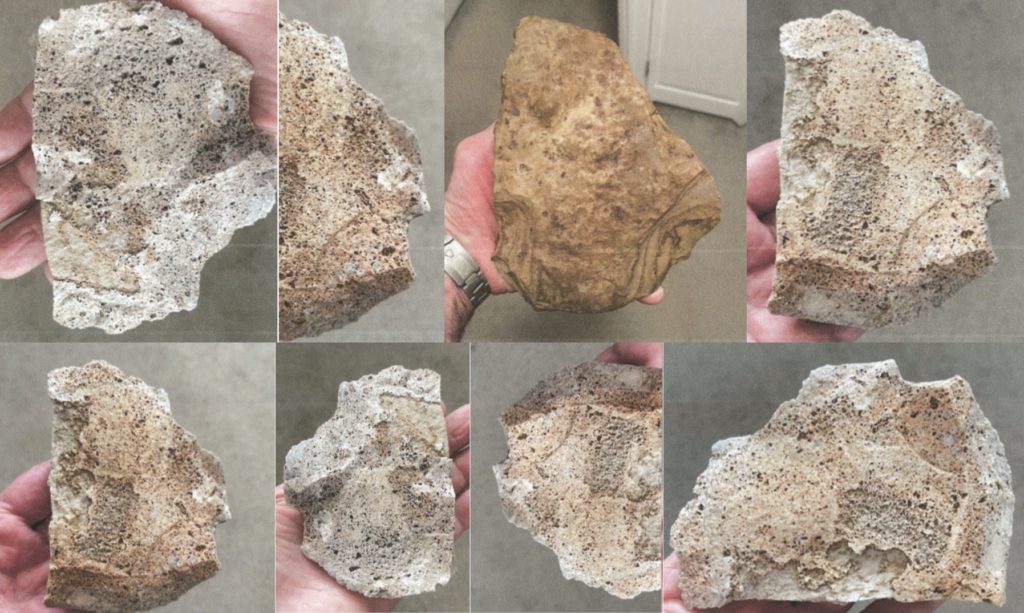
Figure 5
Figure 6.
This example may prove to be one of the finest, most informative Story Stones in northern North America. While it lacks colorful features, their absence is offset by ingenious, creatively-designed imagery. Several animals have been depicted, and most importantly, two human faces. Their profiles are beautifully contoured by careful sculpting. When viewed sideways, a proboscidean — perhaps a mastodon comes into view. A natural inclusion in the rock serves as its eye. The mastodon’s trunk and a tusk lying alongside it are shown by flaking. The back of the mastodon, on the other hand, has been sculpted by cutting small grooves. When the sculpture’s right is viewed, a beaver may be seen, The beaver’s front leg and one of its feet extend underneath its head. When viewed vertically, we observe two well-sculpted human faces. The upper face appears to be young and smiling and wears a horned cap or headdress. The face beneath appears older and wise. It has eyes and a cheek that have been delineated by grooving. We also may see a pipe or a stem of a gourd coming out of the mouth of the lower face. On the opposite side – the cortex side – there are three images depending upon natural holes in the rock for their eyes. One is a proboscidean (mastodon?), another a bear, and the third possibly a porcupine. Dimensions are 2 3/4″ X 1 7/8″ X 1/2” (thick).
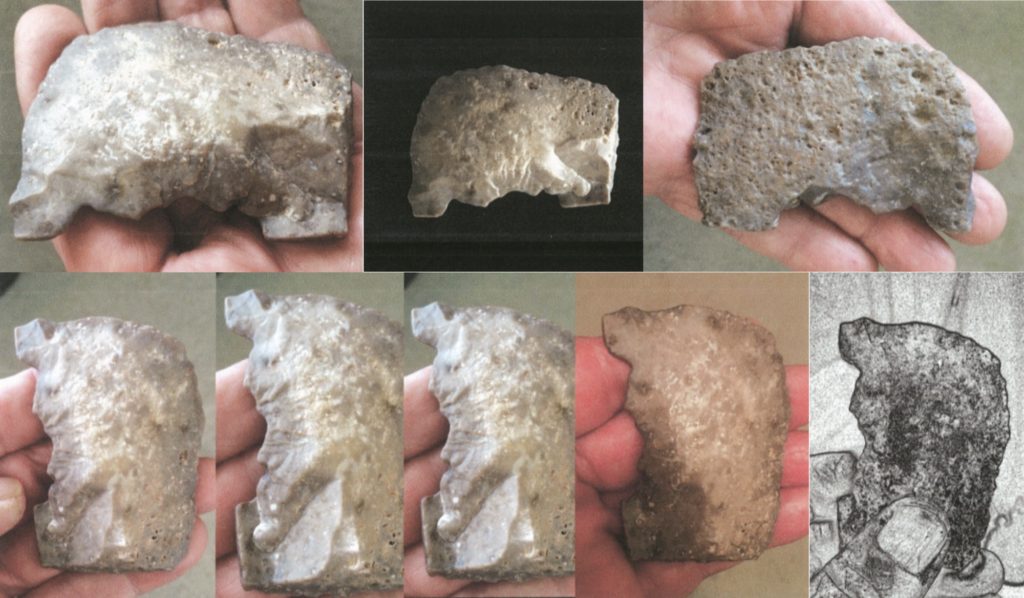
Figure 6
Figure 7.
This Story Stone continues with the theme of a mammoth or mastodon image connected with a human face (perhaps representing a shaman or deity). In this example the human face is carved into the bottom of the proboscidean’s face. It is looking forward in front of the proboscidean’s head. There are images of a mammoth (?) on both sides of the stone. Turning it vertically, we observe several human faces in profile and as a full view. Even the sloping back of the proboscidean has a head profile looking upward. Yet another face profile looks upward above the animal’s head. Dimensions are 5 1/4″ X 4″ X 3/4″ (thick).
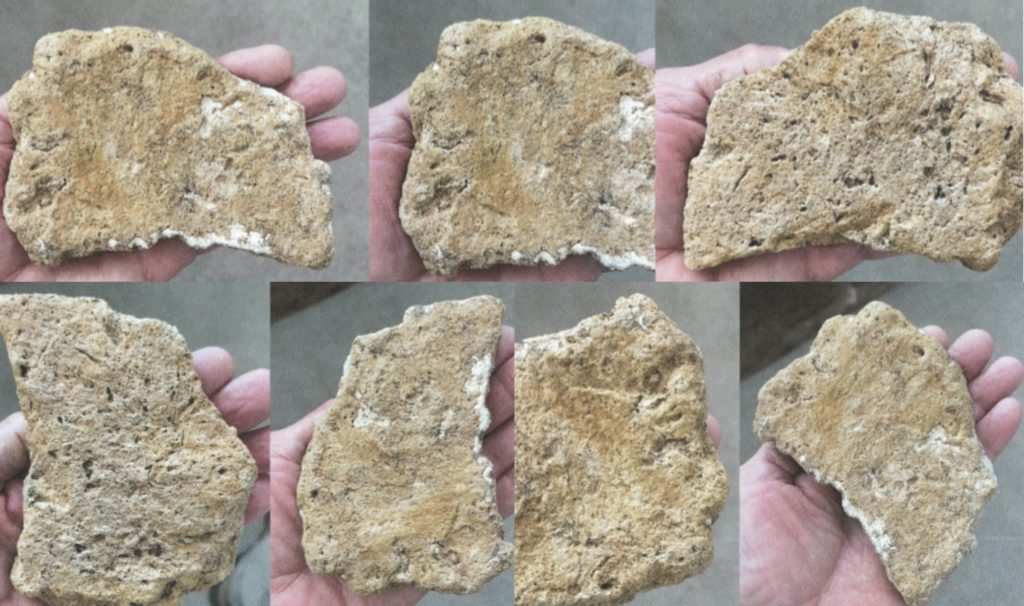
Figure 7
Figure 8.
This specimen is a masterpiece of artistic expression. It depicts several animal images including mastodon, bear, wolf, and cat plus human being. The primary image is a proboscidean (mastodon) facing left with its back tapering downward towards the right. In front of the mastodon we see a human face, facing left. It is bearded and horned – perhaps a shaman. Just above this face in profile is another horned human profile employing the lower human’s eye as its mouth. The eye of this second human profile serves also as the eye of the mastodon. By tilting the mastodon image slightly to the right, the entire profile becomes a large cat’s head. By turning it vertically with the shamans facing downward, we may perceive a head wearing a bird mask having a hooked beak. Further tilting reveals a wolf’s head. The top of the shaman’s cap is its ears and the bottom of the mastodon’s trunk is its snout. Then turning it back vertically again, we see another human head with the eye just below center – head facing left. When we turn the piece over, we observe a proboscidean facing right with its frill behind its head enlarged, making it look larger. We can also see what appears to be a porcupine. Several other figures – a human face profile and animal heads (bear, wolf) embellish this jewel of Palaeo-American art. Dimensions are 2 1/2″ X 2″ X 5/8” (thick).
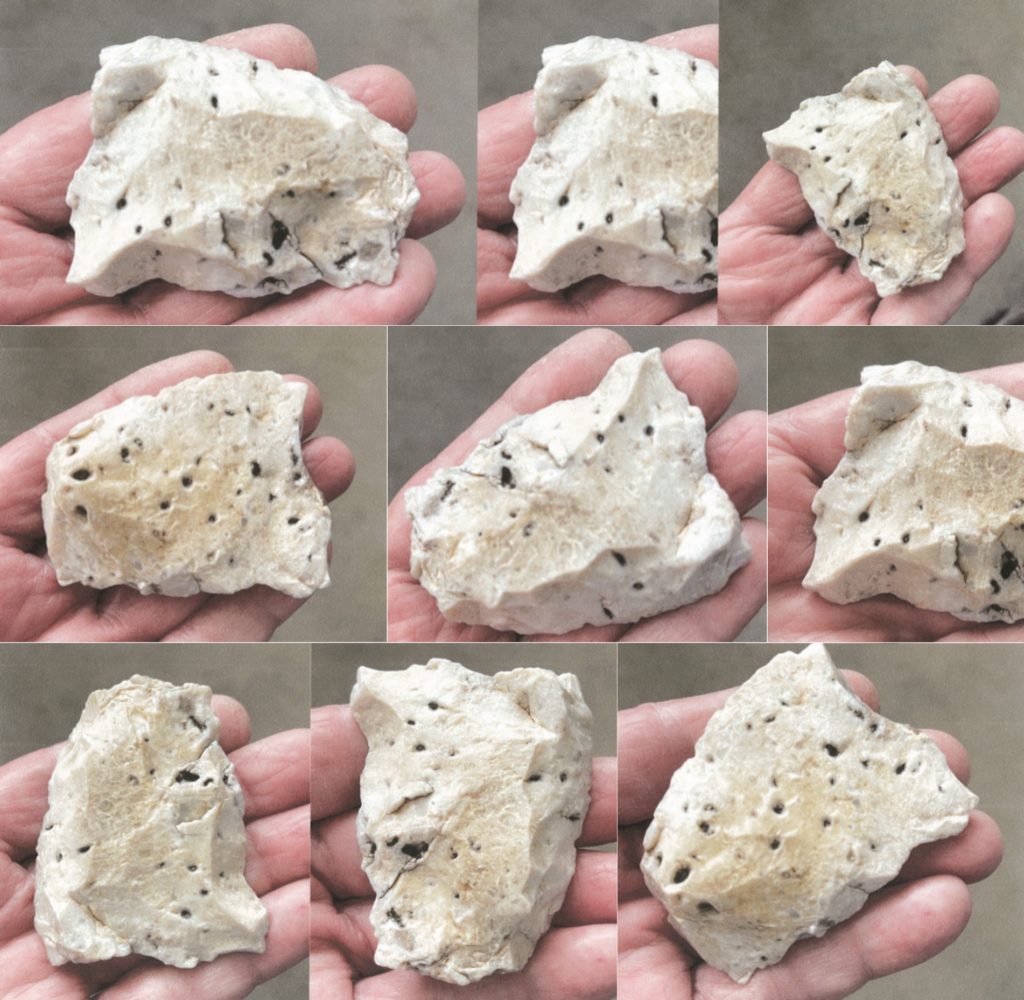
Figure 8
Figure 9.
This very interesting Story Stone portrays four different human faces. One face, looking to the right, appears to be an old individual with hair on top of his head. Right below the nose is a little round ball at the mouth – the mouth being open and implying speech. When we turn it over to the other side with the face looking left, we see a younger, smiling visage. This happy face is patinated a beautiful orange color. When the Story Stone is turned upside down, we see yet another smiling face. When we turn it over, we encounter an older-appearing individual facing left. He may be wearing a cap. Dimensions 3 1/8″ X 1 5/8” X 1/2″ (thick).

Figure 9
Figure 10.
This large Story Stone depicts the faces, old and young, of a human being – perhaps a shaman or deity. The faces are on both sides of the stone and incorporate natural holes and inclusions as eyes and noses. The softer, whitish-gray, rough stone matrix bordering the harder chert has been sculpted to create the noses of two faces. Cat heads are also depicted upon this wonderful Story Stone. Dimensions are 5 5/8″ X 5 3/8″ X 3/4″ (thick).

Figure 10
Figure 11.
This example of a Story Stone was found in Texas. It is a Clovis preform, and therefore confirms the association of Story Stones and Palaeo–Americans. It has been fashioned of Edwards Plateau chert and is well patinated. A proboscidean, perhaps a mammoth, is depicted upon both sides. The mammoth’s eye on one side has been created by flaking; while, the eye upon the other side of the stone is a natural inclusion. When the stone is held vertically, we see a number of human faces in each direction. These faces utilize natural inclusions to show eyes, noses, and mouths. We also observe an eye that is more centralized and belongs to another face (of a shaman?). Dimensions are 6″ by 3″ by 1/2″ thick at the striking platform.
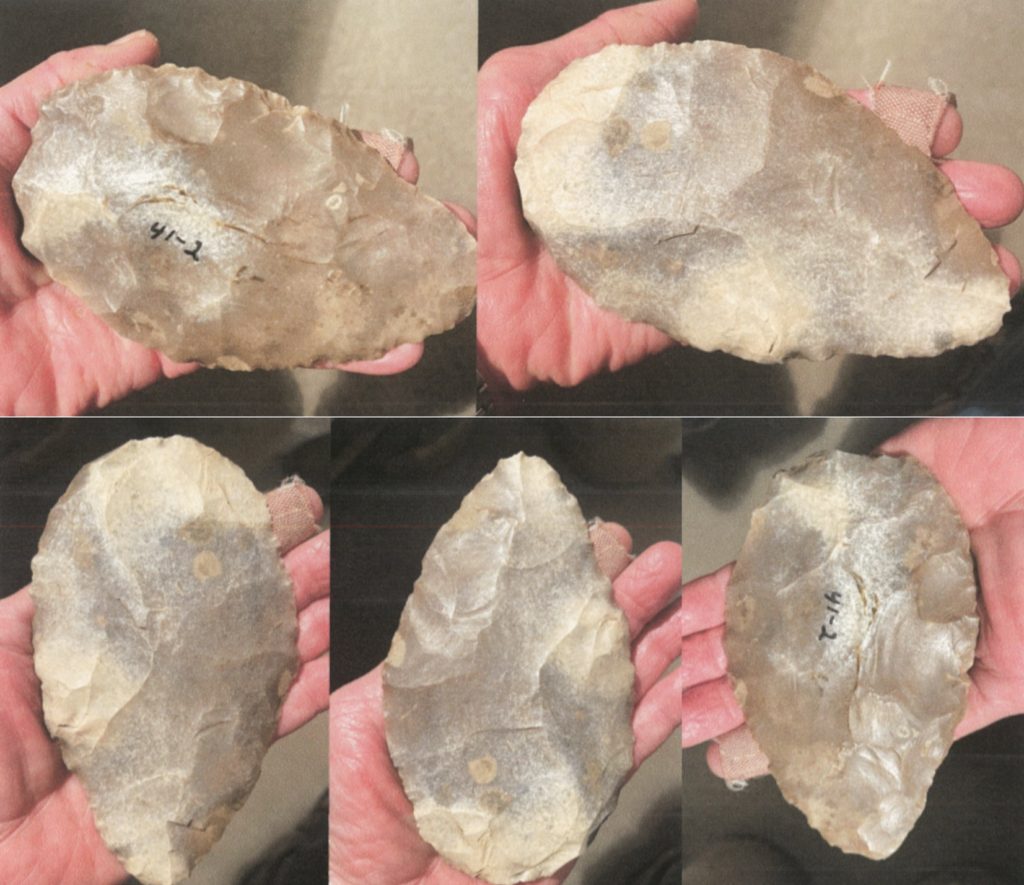
Figure 11
Figure 12.
This specimen is not a Story Stone although it was discovered at a known Clovis site along the shore of Pleistocene Lake Manix. In the opinion of Drs. Michael Gramly and James Harrod this figurine is the first portable, flaked stone, female figurine on record for the Americas. It may depict a pregnant individual, as suggested by the bulbous lower body. Also sculpted are stubby arms and shoulders as well as a simple head. Dimensions are 4 1/8″ tall by 3 1/8” (greatest width) by 1″ (maximum thickness).
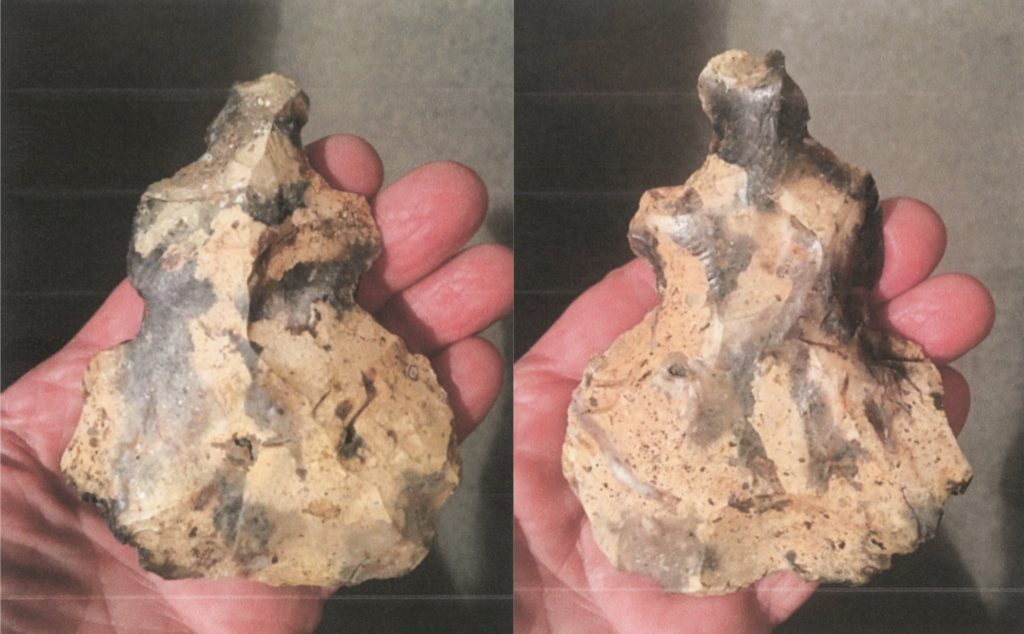
Figure 12
Story Stones have been collected from Clovis sites that border Pleistocene Lake Manix; they occur at locations that likely were islands or peninsulas when the Lake existed or had become marshland. Human groups who made use of this rich environment also may have gathered to celebrate rites of manhood, and Story Stones may have figured in rituals conducted by shamans and group leaders. Since these sculptures appear abundant, a long tradition of ceremonial observances using them is suggested. We might believe there may have been regular competitions for creating the most artistic and informative sculptures. When their religious use had ended, sculptures left lying about might even have been used by children as educational toys.
Similar sculptures might be expected at other Palaeo-American sites across the Americas, and artifact assemblages of that era should be inspected closely for them.
Acknowledgments
I wish to thank Drs. Michael Gramly and James Harrod for their encouragement and help obtaining reference materials.
Richard Dempsey
Long Beach, California February 2021
Hello! I’m at work browsing your blog from my new iphone!
Just wanted to say I love reading your blog and look
forward to all your posts! Carry on the excellent work!
Thanks for your blog, nice to read. Do not stop.