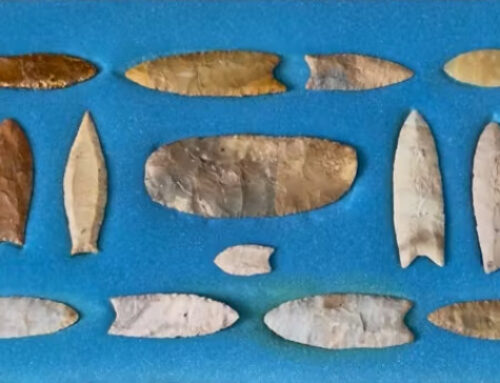
Richard Dempsey’s discovery of Paleo Story Stones represents a sweeping and deeply provocative rethinking of Paleolithic art, artifact recognition, and the symbolic world of early human beings. At the center of his work is a simple but powerful observation: stones, bones, crystals, volcanic glass, meteorites, and other natural materials found across the world often preserve repeated imagery of human faces and mammoths. These are not random curiosities or naturally suggestive rocks, but intentionally worked artifacts, shaped by flaking, grinding, pecking, smoothing, engraving, and careful use of natural inclusions.
Dempsey first recognized this artifact type in October of 2020 in the Mojave Desert, with the first specimen found on Harvard Hill, a presumed Clovis site along the ancient shoreline of Pleistocene Lake Manix. What began as the recognition of one unusual object became a much larger discovery. Once he learned what to look for, the pattern repeated itself over and over again. The same imagery appeared in rhyolite, agate, chert, petrified wood, rose quartz, citrine crystal, obsidian, volcanic glass, Libyan Desert Glass, meteorites, bone, antler, horn, fossil coral, mammoth leg bone, bison bone, and other materials.
The defining structure of the Paleo Story Stone is the repeated pairing of two human faces and two mammoths or proboscideans. Typically, one face is young and one is old. One mammoth is juvenile and one is mature. The imagery is not always presented in a single obvious view. Instead, the artifact must be rotated. A profile that appears to be a mammoth in one orientation becomes a human face in another. A natural hole becomes an eye. A band of cortex becomes hair. A flaked ridge becomes a trunk. A polished perimeter becomes the forehead of an older face. This layered visual language is one of the most important parts of the discovery.
What makes Dempsey’s work significant is not only the identification of individual effigies, but the recognition of a system. The same iconography appears repeatedly across geography, material, and time. A baby mammoth often appears with a small beak-like trunk and exaggerated eye. A mature mammoth often has a sweeping trunk, sloping back, and heavy hair. The younger human face often has a pointed nose and open mouth. The older face often has a larger rounded or drooping nose. Faces often look up from the back of a mammoth. Hair is frequently shown through patterned engraving, grooving, or pecking.
In later Paleo examples, especially those attributed to Clovis or other advanced Paleolithic technologies, the workmanship can be astonishingly refined. Volcanic glass specimens from Mount Shasta show pressure flaking, percussion flaking, patterned engraving, and carefully ground edges. Rose quartz bifaces from South Dakota and Madagascar show flaked eyes, preserved inclusions, and engraved hair. Libyan Desert Glass artifacts show Aterian tanged points, blades, scrapers, and bifaces that were later transformed into effigy offerings. Even flakes that might normally be dismissed as debitage can reveal secondary modification into symbolic forms.
One of the most important identification principles in Dempsey’s work is that natural features were not ignored. They were used. A hole, bubble, inclusion, color band, cortex patch, crystal window, or internal ring could become an eye, mouth, hair tuft, trunk, or face. The ancient maker did not impose imagery on the stone from nothing. Instead, he collaborated with the material. The stone already suggested something, and the artisan completed it.
This is why many Paleo Story Stones have gone unrecognized. They do not always look like conventional artifacts. Archaeology has traditionally been trained to see points, blades, scrapers, hand axes, cores, and flakes. But Dempsey argues that early humans also worked stone for symbolic imagery, and that this work was often subtle. The perimeter matters. The orientation matters. The relation between face and mammoth matters. The location of the eye matters. The difference between natural ripple marks and intentional engraving matters. Once those patterns are understood, stones previously dismissed as rough, odd, or natural can be reexamined as worked artifacts.
The historical significance, if Dempsey’s interpretation is accepted, is enormous. It would mean that Paleolithic symbolic expression was far more common, portable, and globally distributed than previously understood. It would also suggest that mammoth imagery was not merely decorative. It may have carried spiritual, social, or mythological meaning. Dempsey often frames this as a worldwide mammoth tradition, possibly a form of mammoth reverence, protector symbolism, or creation story that endured until mammoths disappeared around 11,000 years ago. In that view, the end of the mammoth also marked the end of the Story Stone tradition.
Some of the most powerful examples are not stone at all. A proboscidean leg bone from southwestern Nebraska, reportedly hollowed through and shaped into a face and mammoth effigy, led Dempsey to consider whether some Story Stones or Story Bones may have been mounted on poles as protective talismans. The glowing eye created by light passing through the worked bone suggests that the object may have been designed for display, perhaps at the entrance to a camp. This opens a more imaginative but compelling possibility: that these objects were not just art, not just tools, and not just offerings, but guardians.
The idea of protective eyes runs through many later cultures, from ancient eye beads to talismanic carvings. Dempsey sees Paleo Story Stones as part of that much older human impulse. The mammoth, the most powerful land animal of the Pleistocene world, may have served as a protector figure. The young and old faces may represent generations, ancestors, shamans, family, transformation, or human continuity. The young and mature mammoths may represent life cycle, power, fertility, memory, or origin.
What is especially striking is the way utility and symbolism overlap. Many artifacts begin as tools. Aterian tanged points made from Libyan Desert Glass may have served as spear points, knives, or scrapers before being reworked into effigy offerings. Rose quartz knives and scrapers may have been used, then converted at the end of their useful life. Clovis-style bifaces and cache blades may have been made as offerings rather than ordinary utilitarian tools. Large flakes may have been struck from a parent stone, then engraved and modified into mammoth and face imagery. In Dempsey’s interpretation, the life of the tool did not end when its edge dulled. It became something more.
The material choices also matter. These artifacts appear in ordinary stone, but also in extraordinary materials: cobalt blue volcanic glass, periwinkle volcanic glass, ruby red glass, Libyan Desert Glass, citrine crystal, rose quartz, meteorite, and translucent agate. These were visually powerful materials. Light passed through them. Colors shifted. Inclusions appeared like eyes. Glass could be engraved. Crystal could be polished. Meteorite could be shaped. The material itself likely carried meaning.
Dempsey’s work also challenges the boundary between artifact and art. In many cases, the same object is both. A Clovis biface can be a cutting implement, a cache blade, a face, a mammoth, and an offering. A large flake can be debitage to one observer and a completed effigy to another. A rose quartz rough specimen sold by a rock dealer can become, under closer examination, a flaked and engraved Paleo artifact. His discovery asks us to look again at what has been sitting in collections, shops, fields, and museum drawers.
The importance of this discovery lies in the possibility that a vast category of Paleolithic art has been overlooked because it did not fit the expected form. Cave paintings are obvious. Sculpted figurines are obvious. Projectile points are obvious. But a stone that must be rotated, read, and interpreted through repeated iconographic rules is easier to miss. Dempsey’s claim is that these objects were always there, everywhere, but no one had learned to read them.
At its most creative level, the discovery suggests that early humans were not merely surviving. They were remembering. They were honoring. They were encoding stories into stone. They were placing faces inside mammoths and mammoths inside faces. They were linking youth and age, animal and human, tool and spirit, earth material and cultural meaning.
Perhaps the most extraordinary aspect of Richard Dempsey’s discovery is not simply that he identified a previously unrecognized artifact type, but that he recognized an entire symbolic language hidden in plain sight across the archaeological record of the world. For generations, museums, universities, collectors, geologists, archaeologists, and rock dealers handled these objects without realizing what they were. Flakes were dismissed as debitage. Crystal artifacts were sold as rough. Volcanic glass was mislabeled as industrial slag. Meteorites, bifaces, scrapers, hand axes, and worked stones containing repeated mammoth and facial imagery sat unnoticed because no one had recognized the iconographic system connecting them. Richard Dempsey changed that.
His discovery forces a reconsideration of Paleolithic symbolic behavior on a global scale. If these effigies are what he argues they are, then the implications are enormous. It means Paleolithic peoples across the world shared recurring artistic themes, repeated mammoth symbolism, paired human imagery, engraving traditions, and deeply sophisticated visual storytelling stretching back potentially hundreds of thousands, or even millions, of years. It means portable symbolic art was vastly more widespread than previously imagined. It means some of the oldest religious or mythological traditions in human history may have survived encoded in stone, crystal, glass, bone, and meteorite.
Equally important is Dempsey’s work on naturally occurring volcanic glass, including the material widely sold today as “Andara glass.” Long dismissed or misunderstood as industrial slag by many collectors and dealers, Richard was the first to pursue formal XRF scientific testing through the Stephen F. Austin State University geology department, helping establish the volcanic origin of these remarkable materials. At the same time, he recognized that many of these specimens also preserve unmistakable evidence of Paleolithic workmanship through flaking, grinding, engraving, and symbolic modification. In doing so, he not only redefined the artifacts themselves, but also transformed how the material they were made from is understood.
Whether history ultimately views Richard Dempsey as a revolutionary outsider, a controversial pioneer, or one of the most important artifact discoverers of the modern era, his work has already opened a door that cannot easily be closed. He has challenged archaeology, geology, and anthropology to look again at objects the world thought it already understood. And in that sense alone, his discovery stands as one of the most provocative and potentially transformative archaeological revelations of our time.
Richard Dempsey’s Paleo Story Stones therefore matter because they invite a new way of seeing. They ask whether Paleolithic people carried their stories not only on cave walls, but in their hands. They ask whether the simplest flake could hold a myth. They ask whether the mammoth was not only hunted, but revered. And they ask whether the human imagination is far older, more widespread, and more material than we have allowed ourselves to believe. In that sense, the discovery of Paleo Story Stones stands not merely as a new archaeological observation, but as a profound rewriting of humanity’s earliest symbolic and spiritual history.